
Enterprise AI data pipelines stall when storage can't keep up. Tiger Bridge bridges the gap between on-premises data and cloud AI - at every stage of the pipeline.
AI doesn't fail because of bad models. It fails because of bad data access. The most advanced GPU clusters in the world still starve when the storage layer can't feed them. That bottleneck is where Tiger Bridge lives - and where it quietly solves one of enterprise AI's most underappreciated problems.
Mission-critical industries - healthcare, finance, media, manufacturing - are under mounting pressure to deploy AI at scale. Yet the data those AI systems need is overwhelmingly on-premises: constrained by regulation, security mandates, latency requirements, and sheer operational inertia. Cloud-based AI services, meanwhile, are where the processing power lives. The result is a structural disconnect that no amount of model tuning can fix.
Tiger Bridge addresses this directly. As a software-only hybrid cloud engine, it allows organizations to maintain their on-premises operations exactly as they are today - while opening a seamless, intelligent pipeline to cloud AI services. But to understand why this matters, we first need to look at how AI workloads actually consume storage.
Enterprise AI Data Needs More Than Fast Storage
A common instinct in enterprise AI planning is to treat storage as a uniform concern - the pipeline needs fast storage, so you buy fast storage. In practice, this approach fails because the I/O demands of an AI pipeline shift dramatically depending on which stage you are in.
Think about what actually happens as data travels through an AI workload. Raw data arrives at scale - video files, medical records, sensor logs, documents - and needs to be ingested cost-effectively. That data then gets prepared: chunked, cleaned, annotated, converted into formats a model can consume. Training runs pound through massive datasets with sequential reads at high throughput. Inference demands something quite different - low-latency random access, fast model loading, rapid retrieval. And when all of that processing is done, much of the data moves into long-term archive.
Each of these stages has a fundamentally different storage profile. Ingest and archive benefit from the economics and scale of object storage. Training runs best against a high-throughput file system. Preparation and inference require the flexibility to access data via both file and object protocols simultaneously.
The organizations winning with enterprise AI are not necessarily those with the most compute. They are the ones that have solved data movement - getting the right data to the right system at the right stage, automatically, without manual intervention.
A storage architecture that can't serve the right protocol at each stage forces teams to copy data between silos. That means latency, storage bloat, and pipeline delays that directly translate into wasted GPU time and missed business outcomes - not to mention the operational overhead of engineers spending cycles on data wrangling rather than building.
What the AI Pipeline Actually Looks Like
We can break the enterprise AI data lifecycle into distinct stages, each with specific storage characteristics. Understanding this progression is the foundation for understanding where Tiger Bridge creates value.
As per Gartner®, there is a preferred type of storage for each stage of the AI pipeline (as shown in the figure).
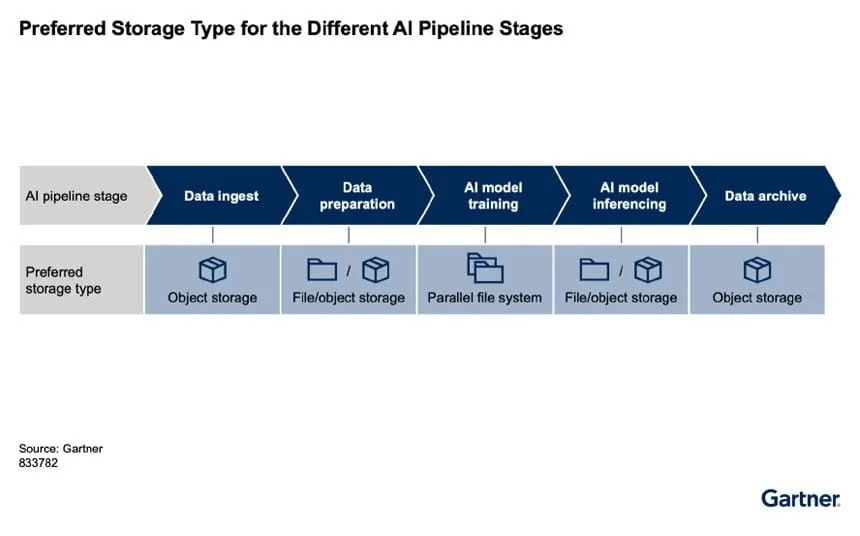
Source: Gartner, "The Generative AI Data Storage Playbook", byChandra Mukhyala, Julia Palmer, 8 January 2026, Figure 1: Preferred Storage Type for the Different AI Pipeline Stages. GARTNER is a registered trademark and service mark of Gartner, Inc. and/or its affiliates in the U.S. and internationally and is used herein with permission. All rights reserved.
The pattern here is telling. The pipeline doesn't have one storage need - it has at least three distinct profiles, and the critical middle stages require the flexibility to work with both file and object access simultaneously. This is where most enterprise AI architectures hit friction, and where Tiger Bridge's hybrid cloud approach delivers the most direct value.
Tiger Bridge as the AI Data Lifecycle Engine
Tiger Bridge is not a storage system in the traditional sense. It is a software layer that sits transparently between your existing on-premises infrastructure and the cloud - extending, tiering, and synchronizing data without disrupting the workflows already in place. For AI pipelines, this means handling the movement of data between storage tiers automatically, aligned with the demands of each stage.
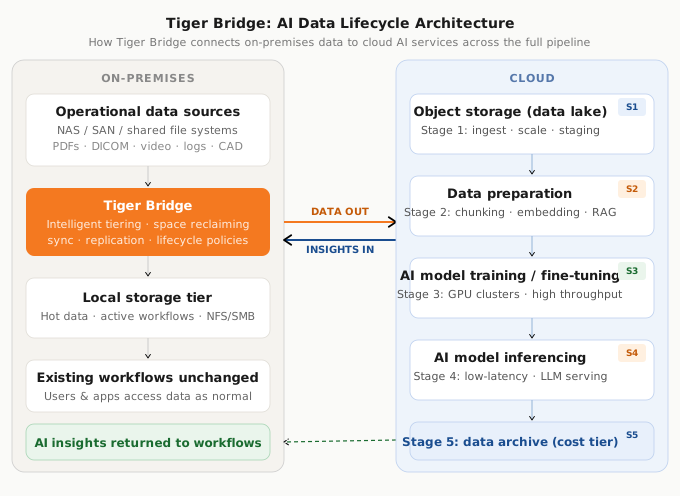
The diagram illustrates what makes Tiger Bridge distinctive in the AI context. It doesn't require organizations to choose between on-premises and cloud - it operates as the intelligent connective tissue between them. Data generated by on-premises operational systems is automatically tiered, staged, and made available to cloud AI services at each pipeline step, with AI-processed insights written back into existing workflows without any change to how users or applications interact with the data.
Stage by Stage: What Tiger Bridge Does
The value becomes concrete when mapped against each of the five pipeline stages:
| Pipeline stage | Storage profile | Tiger Bridge role |
|---|---|---|
| Data ingest | Object (scalability) | Automatically tiers on-premises files to cloud object storage via intelligent policies. Files are replaced with lightweight stubs locally; cloud copies become immediately accessible for downstream AI ingestion with no manual data movement. |
| Data preparation | File + object | Tiger Bridge's single global namespace presents data through both file and object protocols simultaneously. Chunking and embedding pipelines access source documents directly without format conversion or ETL overhead. |
| AI model training | High throughput | Large training datasets staged in cloud object storage are surfaced to GPU clusters via high-throughput protocols. Tiger Bridge handles the data movement pipeline so training workloads are never blocked waiting for data access. |
| AI model inferencing | File + object | Processed AI outputs and model results are written back through Tiger Bridge into on-premises workflows, integrating transparently with existing applications. No re-engineering, no new interfaces for end users. |
| Data archive | Object (cost effectiveness) | Cold and processed data is automatically migrated to low-cost cloud archive tiers based on metadata-driven lifecycle policies, reducing on-premises storage footprint by over 60% while maintaining full retrievability on demand. |
Why the Hybrid Storage Approach Matters for Regulated Industries
There is a reason Tiger Bridge has been adopted across healthcare, finance, and media organizations: many of them simply cannot move their primary operational enterprise AI data to the cloud wholesale. Regulatory constraints, data residency requirements, and security policies make full cloud migration a non-starter for the data that matters most.
Tiger Bridge's on-premises-first architecture is built for exactly this reality. The primary data stays where compliance requires it. The AI processing happens in the cloud. And the intelligence derived from that processing flows back into on-premises workflows - creating a closed loop that delivers AI value without compromising data governance.
This is materially different from approaches that require full migration or that treat cloud as the system of record. Tiger Bridge treats on-premises as the authoritative environment, with cloud as the processing and scaling layer - not the other way around.
No workflow disruption
Users and applications continue operating exactly as before. Tiger Bridge works transparently beneath existing infrastructure - no retraining, no new interfaces.
Elastic scale without hardware
Cloud storage expands capacity on demand. Organizations avoid overprovisioning on-premises systems to accommodate growing AI datasets.
Storage-agnostic by design
Works across any storage provider, type, or tier - Microsoft Azure, AWS, Google Cloud, IBM Cloud, and more. No vendor lock-in at any layer of the stack.
Data sovereignty preserved
Primary data remains on-premises. Granular control over what is tiered, when, and to which cloud environment - designed for regulated industries.
Automated lifecycle management
Policy-driven migration moves cold data to low-cost tiers automatically, ensuring fast storage is reserved for active AI workloads and hot operational data.
The organizations that will lead in AI over the next decade are not necessarily those with the biggest model budgets. They are the ones that can move data efficiently, govern it responsibly, and connect their existing operational knowledge to the AI services that can make sense of it. Tiger Bridge is the infrastructure layer that makes that possible - without asking organizations to rebuild what already works.